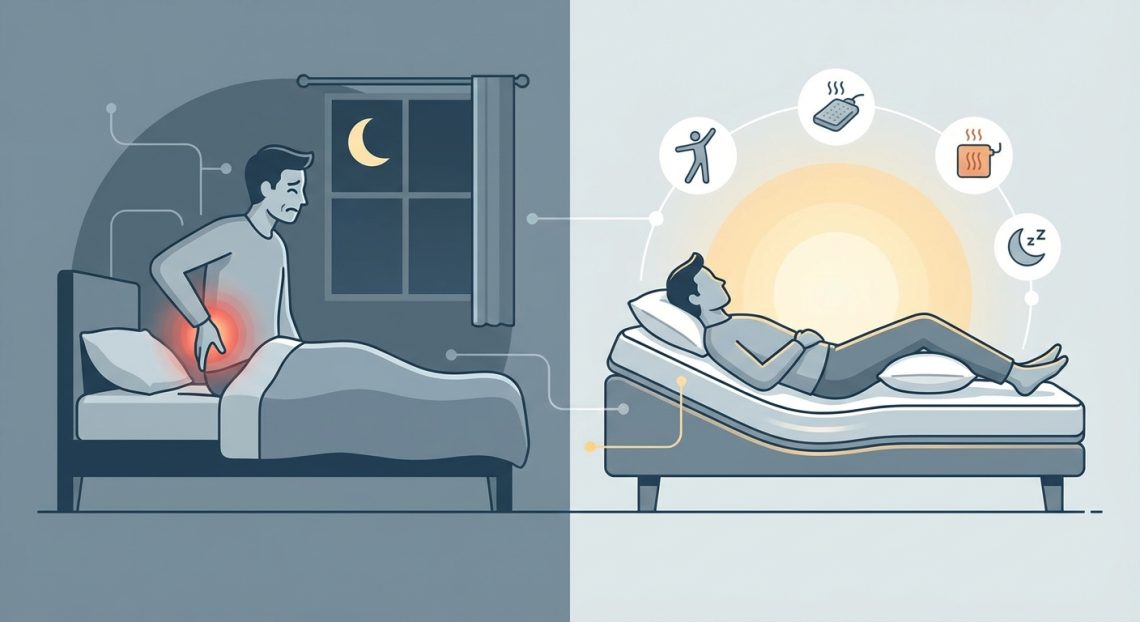
You settle into bed after a long day, ready for rest. But the moment your head hits the pillow, your lower back starts screaming. The dull ache that was barely noticeable during your commute home suddenly feels unbearable.
You’re not imagining it. Back pain genuinely intensifies for many people once the sun goes down.
Nighttime back pain worsens due to reduced circulation, inflammatory processes that peak during rest, decreased distraction from daytime activities, poor sleep positions, and pressure on spinal structures. Relief comes through strategic positioning, targeted stretches, temperature therapy, and addressing underlying conditions. Most cases improve with consistent bedtime routines, but persistent severe pain warrants medical evaluation to rule out serious conditions.
Why Your Back Hurts More After Dark
Your body operates on rhythms you might not consciously notice. Pain perception changes throughout the day based on hormone levels, inflammation patterns, and nervous system activity.
During daylight hours, your body produces higher levels of cortisol. This natural steroid helps suppress inflammation and pain signals. As evening approaches, cortisol drops. Inflammatory markers rise. The pain you barely registered at 2 PM becomes impossible to ignore at 10 PM.
Your circulation slows when you lie down. Blood flow decreases to certain areas. Inflammation pools around irritated tissues. Swelling increases pressure on nerve endings.
Then there’s the distraction factor. During the day, your brain juggles dozens of inputs. Work emails. Traffic sounds. Conversations. Your back might hurt, but your attention stays divided. At night, those distractions vanish. Your bedroom is quiet. Your mind has nowhere else to focus except the throbbing in your lumbar spine.
Common Culprits Behind Nighttime Back Pain
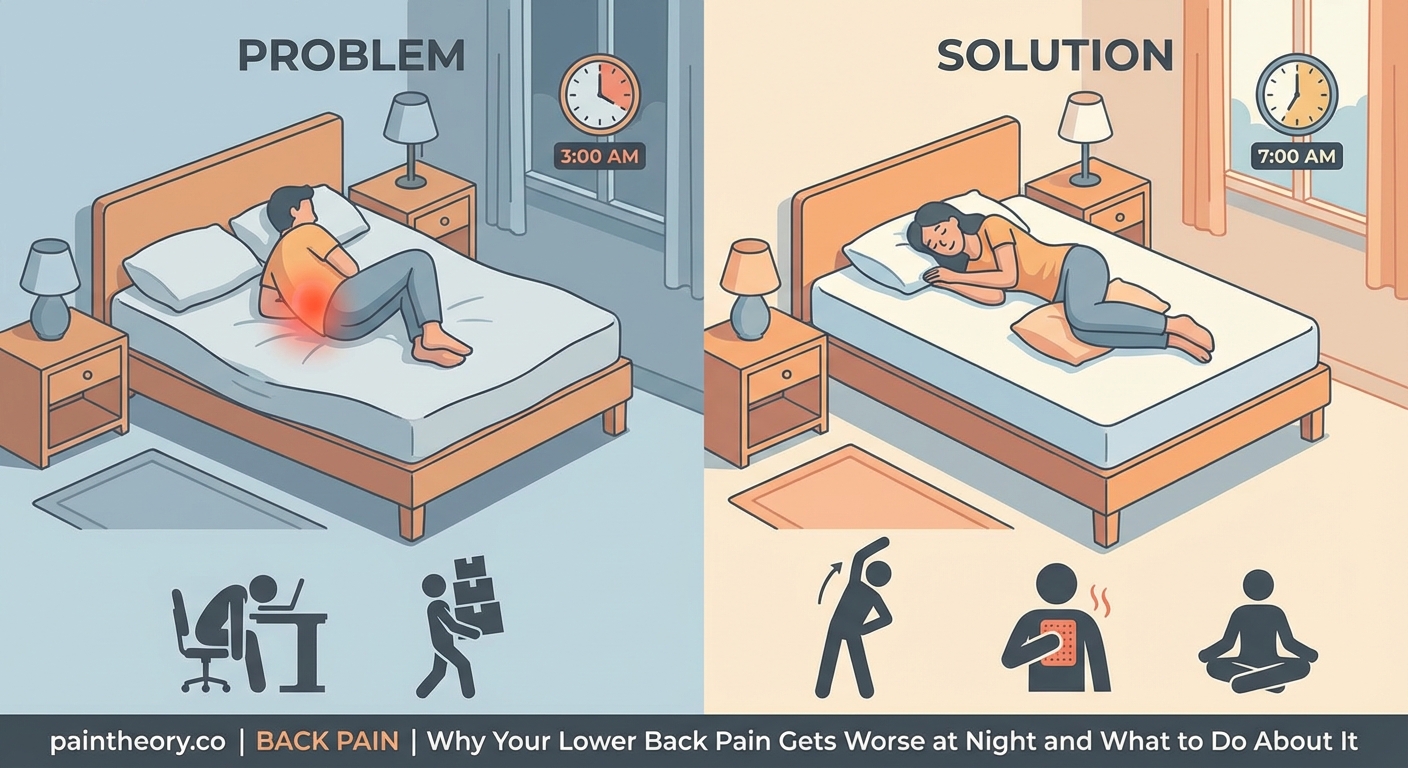
Several specific conditions become more symptomatic once you’re horizontal.
Degenerative disc disease causes discs between vertebrae to lose height and cushioning. Lying down changes spinal loading patterns. Pressure shifts to areas already damaged by wear and tear.
Herniated discs can press against nerves differently depending on your position. What feels manageable while standing might become excruciating when you recline.
Spinal stenosis narrows the spaces where nerves travel through your spine. Certain positions compress these already tight passages. Many people with stenosis feel worse lying flat.
Ankylosing spondylitis causes inflammatory back pain that characteristically worsens with rest. People with this condition often wake up stiff and sore after several hours in bed.
Fibromyalgia amplifies pain signals throughout the body. Sleep disturbances common with this condition create a vicious cycle where poor rest increases pain sensitivity.
Muscle strain from overuse during the day might not fully register until you finally stop moving. Tense muscles stiffen as you rest. Trigger points become more active.
Sleep Positions That Make Everything Worse
How you arrange your body matters tremendously.
Stomach sleeping ranks as the worst position for your back. This position hyperextends your lower spine and forces your neck into awkward rotation. Your lumbar curve gets flattened or reversed. Pressure concentrates on facet joints.
Side sleeping without proper support creates problems too. Your top leg pulls your pelvis forward. Your spine twists. The natural curve in your lower back loses support and sags toward the mattress.
Back sleeping seems ideal, but only if done correctly. Without support under your knees, your legs lie flat. This position tilts your pelvis and increases the arch in your lower back. Muscles strain to maintain this position for hours.
Your mattress plays a supporting role. Too soft allows your body to sink unevenly. Your spine curves in unnatural ways. Too firm creates pressure points. Your muscles never fully relax because they’re fighting against the surface.
Old mattresses lose their supportive properties. That mattress you bought eight years ago has probably developed permanent indentations. You’re essentially sleeping in a hammock shaped to yesterday’s body position.
Practical Steps to Reduce Nighttime Pain
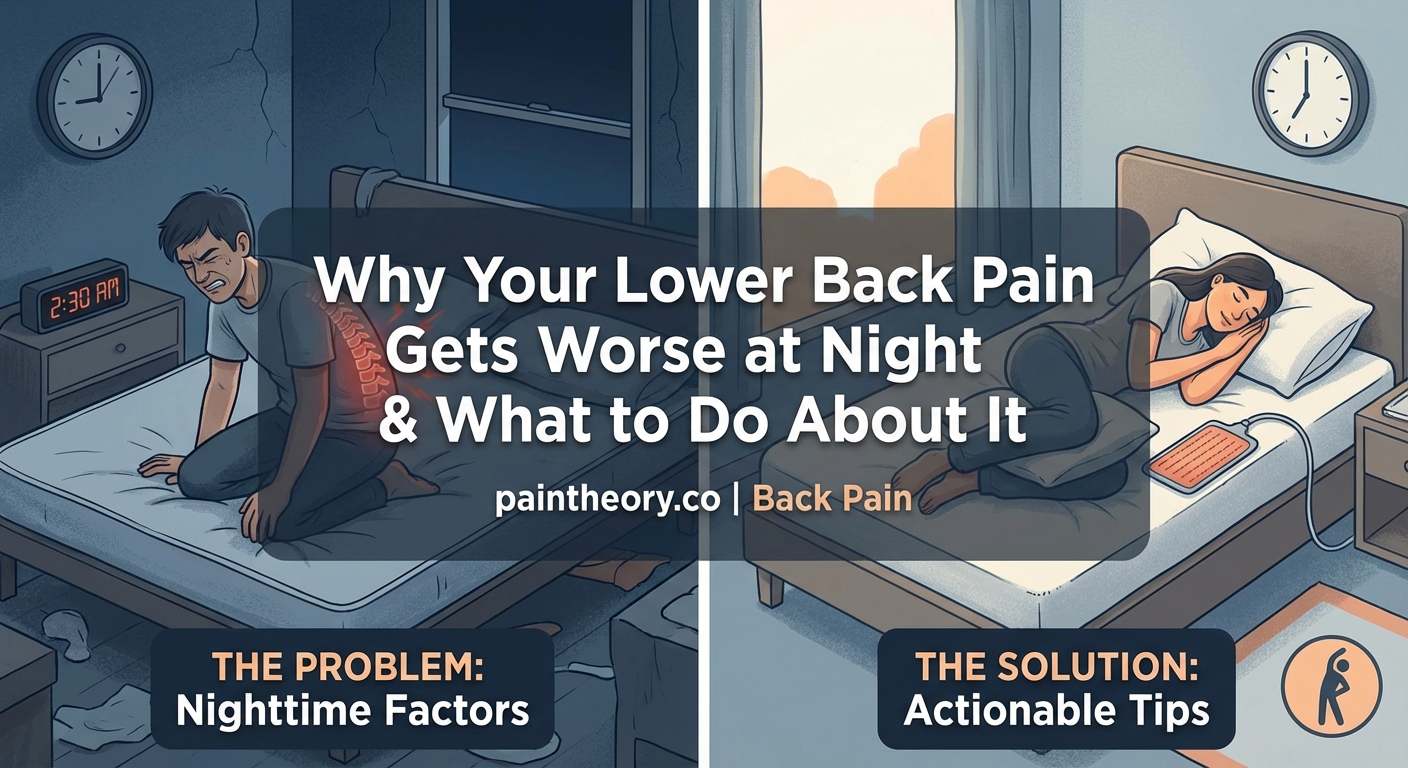
You can take action tonight to improve your situation.
1. Optimize Your Sleep Position
Choose back or side sleeping over stomach sleeping.
For back sleepers:
– Place a pillow under your knees to reduce lumbar curve
– Use a small rolled towel under your lower back if needed for support
– Keep your pillow height moderate so your neck stays neutral
For side sleepers:
– Put a pillow between your knees to keep hips aligned
– Consider a body pillow to prevent rolling forward
– Ensure your pillow keeps your head level with your spine
2. Prepare Your Body Before Bed
Create a 15-minute wind-down routine:
– Gentle stretching to release muscle tension
– Heat application to increase blood flow
– Deep breathing to activate your parasympathetic nervous system
3. Address Inflammation Proactively
Take anti-inflammatory measures before pain peaks:
– Apply ice if you have acute injury or swelling
– Use heat for chronic muscle tension
– Consider over-the-counter anti-inflammatory medication with food
Stretches That Actually Help
Timing matters as much as technique. Stretch 30 to 60 minutes before bed, not right before lying down. This gives your muscles time to relax without remaining overly loose.
Child’s pose gently stretches your lower back and hips. Kneel on the floor. Sit back on your heels. Reach your arms forward and lower your chest toward the ground. Hold for 60 seconds. Breathe deeply into your back.
Knee to chest stretch releases tension in your lumbar spine. Lie on your back. Pull one knee toward your chest. Hold for 30 seconds. Switch sides. Then pull both knees together for another 30 seconds.
Figure four stretch targets your piriformis muscle. Lie on your back. Cross one ankle over the opposite knee. Pull the uncrossed leg toward your chest. You should feel a stretch deep in your hip. Hold 30 seconds per side.
Cat-cow movements mobilize your entire spine. Get on hands and knees. Arch your back while looking up. Then round your spine while tucking your chin. Move slowly through 10 repetitions.
“The best stretch is the one you’ll actually do consistently. Choose two or three movements that feel good for your body and make them non-negotiable parts of your bedtime routine.” — Physical therapy principle
Temperature Strategies for Pain Relief
Heat and cold work through different mechanisms.
Cold therapy reduces inflammation and numbs nerve endings. Use ice when:
– You have acute injury or flare-up
– The area feels warm to touch
– Swelling is visible
– Pain started within the last 48 hours
Apply ice for 15 to 20 minutes. Use a barrier like a thin towel between ice and skin. Never fall asleep with ice in place.
Heat therapy increases blood flow and relaxes muscles. Use heat when:
– Pain is chronic and muscular
– Muscles feel tight or knotted
– Stiffness is your primary complaint
– You need to increase flexibility before stretching
Apply heat for 15 to 20 minutes. Heating pads work well. Warm baths provide full-body benefits. Some people prefer alternating heat and cold.
The Pillow Strategy Guide
Strategic pillow placement changes everything.
| Sleep Position | Pillow Placement | Purpose |
|---|---|---|
| Back | Under knees | Reduces lumbar curve strain |
| Back | Small roll under lower back | Maintains natural arch |
| Side | Between knees | Keeps hips and spine aligned |
| Side | Behind back | Prevents rolling backward |
| Side | Under waist | Fills gap between ribs and hips |
| Any | Under head | Keeps neck neutral with spine |
Experiment with different pillow thicknesses. Your body pillow between your knees might need to be thicker than you initially think. The goal is keeping your top hip directly above your bottom hip.
Some people benefit from a small pillow under their abdomen when side sleeping. This prevents the torso from rotating forward.
When Nighttime Pain Signals Something Serious
Most back pain improves with conservative measures. But certain patterns demand medical attention.
Seek evaluation if you experience:
- Pain that wakes you from sleep multiple times per night
- Progressive weakness in your legs
- Numbness or tingling that spreads or worsens
- Loss of bowel or bladder control
- Unexplained weight loss accompanying back pain
- Fever with back pain
- Pain following significant trauma
- No improvement after six weeks of self-care
Nighttime pain that feels better with movement but worse with rest might indicate inflammatory conditions like ankylosing spondylitis. This pattern differs from mechanical pain, which typically improves with rest.
Pain radiating down one or both legs suggests nerve involvement. Sciatica often worsens when lying down due to position-dependent nerve compression.
Lifestyle Factors That Compound Nighttime Pain
What you do during the day affects how you feel at night.
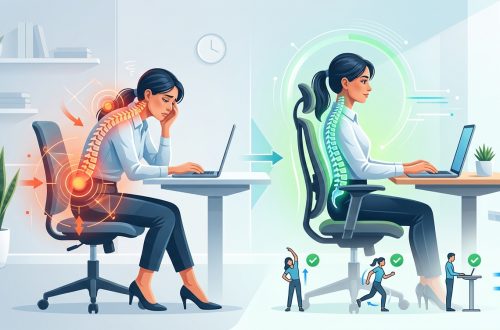
Prolonged sitting tightens your hip flexors. These shortened muscles pull on your pelvis. Your lower back compensates. By bedtime, everything feels locked up.
Dehydration affects disc health. Your intervertebral discs are mostly water. They rehydrate overnight when not bearing weight. Chronic dehydration impairs this process.
Poor daytime posture creates cumulative stress. Your body adapts to slouched positions. Muscles develop imbalances. Some become overstretched and weak. Others become tight and overactive.
Stress and anxiety increase muscle tension. Your body holds stress physically. Many people unconsciously tense their back muscles during stressful situations. This tension persists into the evening.
Lack of regular movement weakens supporting muscles. Your core, glutes, and back muscles need regular activation. Weakness in these areas forces your spine to handle loads it wasn’t designed to bear alone.
Building a Pain-Reducing Evening Routine
Consistency creates results. Random interventions help occasionally. Systematic routines transform outcomes.
Start your routine 90 minutes before bed:
- Finish eating to avoid lying down on a full stomach, which can increase inflammation
- Take a warm shower or bath to relax muscles and increase circulation
- Perform your chosen stretches while muscles are warm and pliable
- Apply heat or cold based on your pain type
- Arrange pillows in your optimal sleep position configuration
- Practice relaxation breathing for five minutes after getting into bed
Track your pain levels and sleep quality. Note which interventions help most. Your body provides feedback. Listen to it.
Some people benefit from light activity after dinner. A 10-minute walk prevents muscles from stiffening during the evening. Don’t exercise vigorously close to bedtime, though. This can increase inflammation and make pain worse.
Mattress and Bedding Considerations
Your sleep surface deserves attention.
Medium-firm mattresses suit most back pain sufferers better than very firm or very soft options. You want enough give to accommodate your body’s curves without excessive sinking.
Mattress age matters. Most mattresses lose supportive properties after seven to ten years. Visible sagging, permanent body impressions, or waking up stiffer than when you went to bed all signal replacement time.
Mattress toppers provide an affordable intermediate solution. A two to three inch memory foam or latex topper can revive an aging mattress. Choose medium density. Too soft creates the same problems as a worn-out mattress.
Adjustable beds allow position customization. Elevating your head and knees simultaneously can reduce pressure on your lower back. Many people with chronic nighttime pain find significant relief with adjustable bases.
Your bed height affects how easily you get in and out. Struggling to stand from a low bed strains your back. Ideally, when sitting on the edge of your bed, your feet should rest flat on the floor with knees at roughly 90 degrees.
Movement Patterns Throughout the Day
Prevention starts when you wake up.
Avoid jumping straight out of bed. Spend 30 seconds doing gentle movements while still lying down. Pull your knees to your chest. Rock side to side. This lubricates joints and prepares muscles.
Take movement breaks every 30 to 45 minutes if you work at a desk. Stand up. Walk around. Do a few stretches. These micro-breaks prevent the cumulative stiffness that makes nighttime pain worse.
Practice proper lifting mechanics. Bend at your knees and hips, not your waist. Keep objects close to your body. Avoid twisting while holding weight.
Strengthen your core consistently. Strong abdominal and back muscles support your spine. Planks, bird dogs, and dead bugs build stability without requiring gym equipment.
Getting the Rest Your Body Needs
Pain and poor sleep create a destructive cycle. Pain prevents quality sleep. Poor sleep increases pain sensitivity. Breaking this cycle requires addressing both elements.
Sleep hygiene basics still apply:
– Keep your bedroom cool, dark, and quiet
– Maintain consistent sleep and wake times
– Limit screen exposure before bed
– Avoid caffeine after early afternoon
– Create a calming pre-sleep environment
Consider your overall sleep position changes throughout the night. Most people shift positions multiple times. Make sure you have pillows positioned to support various positions. Some people keep extra pillows within reach to adjust as needed.
If pain wakes you, have a plan. Getting frustrated makes everything worse. Keep a heating pad or ice pack accessible. Know which gentle stretches you can do in bed. Practice relaxation breathing to calm your nervous system.
Your Path to Better Nights
Back pain worse at night doesn’t have to steal your rest indefinitely. Small, consistent changes add up to significant improvements.
Start with one or two interventions tonight. Maybe that’s adding a pillow between your knees and doing child’s pose before bed. Track how you feel tomorrow morning. Add another strategy in a few days.
Your body has remarkable healing capacity when given the right conditions. Proper support, reduced inflammation, and quality rest allow natural recovery processes to work. Most people notice meaningful improvement within two to three weeks of consistent effort.
Be patient with yourself. Some nights will feel better than others. Progress rarely follows a straight line. But each good night builds momentum toward lasting relief.