Your lower back is screaming by 2 PM. You shift in your chair, trying to find a comfortable position that lasts more than five minutes. By the time you stand up after eight hours at your desk, you feel like you’ve aged twenty years. This isn’t just discomfort. It’s your body telling you that something needs to change.
Back pain from sitting all day stems from sustained compression, muscle imbalances, and reduced spinal disc nutrition. The solution combines regular movement breaks every 30 minutes, targeted stretches for hip flexors and hamstrings, core strengthening exercises, and ergonomic workspace adjustments. Most desk workers see improvement within two to four weeks of consistent practice.
What Sitting Does to Your Spine
Your spine wasn’t designed for eight-hour marathons in a chair. When you sit, the pressure on your lumbar discs increases by 40% compared to standing. That’s like adding an extra bowling ball’s worth of force to your lower back.
The discs between your vertebrae need movement to stay healthy. They don’t have their own blood supply. Instead, they rely on a pumping action that happens when you move. Sitting cuts off this nutrition delivery system.
Your hip flexors shorten and tighten after just 20 minutes of sitting. These muscles attach directly to your lumbar spine. When they’re tight, they pull your pelvis forward, increasing the curve in your lower back and creating strain.
Meanwhile, your glutes turn off. Your core muscles stop engaging. Your back extensors work overtime to keep you upright, leading to fatigue and pain.
The Five Types of Sitting-Related Back Pain
Not all back pain feels the same. Understanding your specific pattern helps you target the right solutions.
Muscle fatigue pain shows up as a dull ache that gets worse as the day progresses. It usually feels better after you move around or stretch.
Disc-related pain often presents as a sharp or burning sensation in your lower back. It might radiate into your buttocks or legs. This pain typically worsens when you sit and improves when you stand.
Facet joint pain creates a localized ache on one or both sides of your spine. It hurts more when you lean backward and often feels stiff in the morning.
Sacroiliac joint pain concentrates in your lower back and buttock area, usually on one side. It can feel like a deep, stabbing sensation that makes it hard to find a comfortable sitting position.
Myofascial pain creates trigger points or knots in your back muscles. These spots are tender to touch and can refer pain to other areas.
Your Movement Prescription
Movement beats any ergonomic chair on the market. Your body needs regular position changes to stay pain-free.
Set a timer for every 30 minutes. When it goes off, stand up for at least two minutes. Walk to get water. Do a few stretches at your desk. The specific activity matters less than breaking up the sitting pattern.
Try these micro-movements while you’re still seated:
- Pelvic tilts: Rock your pelvis forward and backward 10 times
- Seated spinal twists: Turn your torso left and right, holding each side for 5 seconds
- Shoulder blade squeezes: Pull your shoulder blades together 10 times
- Ankle pumps: Point and flex your feet 20 times to keep blood flowing
These movements take less than two minutes but make a significant difference in how your back feels.
The Essential Stretches
Three stretches target the biggest contributors to sitting-related back pain. Do these at least twice during your workday.
Hip Flexor Stretch
- Kneel on your right knee with your left foot flat on the floor in front of you
- Keep your torso upright and gently push your hips forward
- You should feel a stretch in the front of your right hip
- Hold for 30 seconds, then switch sides
Hamstring Stretch
- Sit on the edge of your chair with your right leg extended straight
- Keep your left foot flat on the floor
- Hinge forward from your hips, keeping your back straight
- Reach toward your right foot until you feel a stretch behind your thigh
- Hold for 30 seconds, then switch legs
Figure-Four Stretch
- Sit in your chair with both feet flat
- Cross your right ankle over your left knee
- Gently press down on your right knee while keeping your back straight
- Lean forward slightly to deepen the stretch in your right hip
- Hold for 30 seconds, then switch sides
Building a Resilient Back
Stretching helps, but strengthening creates lasting change. These exercises build the muscular support your spine needs.
Dead Bug
Lie on your back with your arms pointing at the ceiling. Lift your knees to 90 degrees. Slowly lower your right arm overhead while extending your left leg. Return to start and repeat on the opposite side. Do 10 repetitions per side.
Bird Dog
Start on your hands and knees. Extend your right arm forward and left leg backward simultaneously. Hold for 3 seconds, maintaining a neutral spine. Return to start and switch sides. Complete 10 repetitions per side.
Glute Bridges
Lie on your back with knees bent and feet flat. Push through your heels to lift your hips until your body forms a straight line from shoulders to knees. Squeeze your glutes at the top. Lower slowly. Do 15 repetitions.
Planks
Hold a forearm plank position with your body in a straight line. Don’t let your hips sag or pike up. Start with 20 seconds and gradually build to 60 seconds.
Perform these exercises three times per week. They don’t require equipment or much space. You can do them at home before or after work.
Fixing Your Workspace Setup
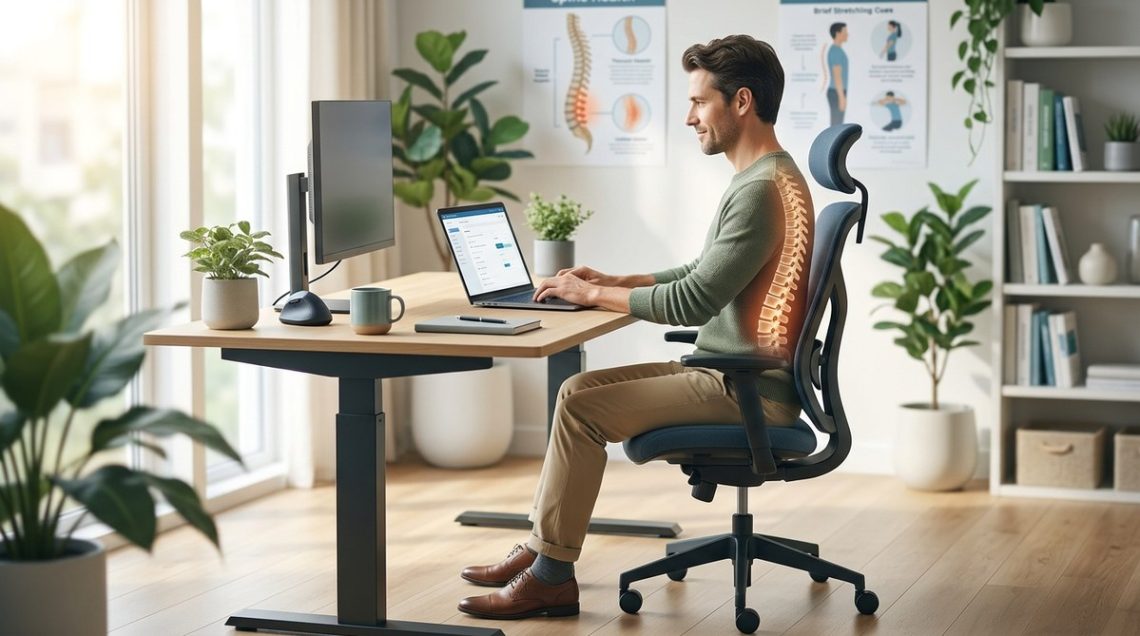
Your chair and desk setup either supports your spine or sabotages it. Small adjustments make a big difference.
| Element | Correct Position | Common Mistake |
|---|---|---|
| Monitor | Top of screen at eye level, 20-26 inches away | Too low, causing forward head posture |
| Keyboard | Elbows at 90 degrees, wrists neutral | Too high, creating shoulder tension |
| Chair height | Feet flat on floor, thighs parallel to ground | Too high, cutting off circulation |
| Lower back | Supported by chair’s lumbar curve | Slouching forward or leaning back too far |
| Armrests | Support forearms without raising shoulders | Too high, causing neck strain |
A small lumbar roll or rolled towel behind your lower back can restore your spine’s natural curve if your chair lacks proper support.
Position your most-used items within easy reach. Twisting repeatedly to grab your phone or reach your mouse creates cumulative strain.
When Sitting Hurts Right Now
You’re in pain and need relief today, not in three weeks. These strategies provide immediate help.
Stand up and walk for five minutes. This simple action decompresses your spine and resets your muscle tension.
Apply heat to your lower back for 15 to 20 minutes. Heat increases blood flow and relaxes tight muscles. A heating pad works, but even a warm towel helps.
Try the child’s pose stretch. Kneel on the floor, sit back on your heels, and reach your arms forward on the ground. This gently stretches your entire back. Hold for 60 seconds.
“The best position is the next position. No single posture, no matter how ergonomically perfect, should be maintained for hours without movement. Your spine craves variety.” – Dr. Stuart McGill, spine biomechanics researcher
If your pain radiates down your leg, feels worse with movement, or includes numbness or weakness, see a healthcare provider. These symptoms suggest nerve involvement that needs professional evaluation.
The Standing Desk Question
Standing desks have become popular as a solution to sitting-related pain. The reality is more nuanced.
Standing all day creates its own problems. It increases pressure on your feet, knees, and hips. It can lead to varicose veins and lower limb fatigue.
The best approach alternates between sitting and standing throughout the day. Start with 20 minutes of standing per hour. Gradually increase as your body adapts.
Use an anti-fatigue mat when standing. Keep one foot elevated on a small box or footrest, switching feet every few minutes. This reduces strain on your lower back.
Don’t stand still. Shift your weight. Take a few steps. The goal is movement variety, not replacing one static position with another.
Common Mistakes That Make Pain Worse
Well-meaning efforts sometimes backfire. Avoid these traps.
Overdoing stretches initially. Your tight muscles didn’t develop overnight. Aggressive stretching can cause more pain. Start gently and progress gradually.
Ignoring pain signals. Discomfort during a stretch is normal. Sharp pain is not. If something hurts beyond a mild stretch sensation, stop.
Sitting on a stability ball all day. These balls force constant micro-adjustments that fatigue your core muscles. Use them for 20 to 30 minutes at a time, not as a full-time chair replacement.
Focusing only on posture. Perfect posture held for hours still causes problems. Movement matters more than position.
Waiting for the pain to become unbearable. Early intervention works better than trying to fix chronic pain. Address discomfort when it first appears.
Building Sustainable Habits
Knowing what to do and actually doing it are different things. These strategies help new habits stick.
Link your stretches to existing routines. Do hip flexor stretches every time you refill your water bottle. Perform glute bridges before your morning shower.
Set up environmental cues. Place a yoga mat by your desk as a visual reminder. Use sticky notes on your monitor to prompt movement breaks.
Track your consistency for two weeks. Put a checkmark on your calendar each day you complete your exercises. This visual progress motivates continued effort.
Start smaller than you think necessary. Two stretches done consistently beat a comprehensive program you abandon after three days.
Find an accountability partner at work. Text each other reminders to stand up and move. Shared commitment increases follow-through.
Why Your Pain Might Persist
Sometimes you do everything right and still hurt. Several factors can complicate recovery.
Poor sleep quality interferes with tissue healing and increases pain sensitivity. If chronic pain keeps you awake, addressing sleep becomes part of your back pain solution.
Stress amplifies pain perception. Your nervous system becomes more sensitive when you’re under chronic stress. Breathing exercises and regular breaks help manage this connection.
Previous injuries create compensation patterns. Your body might be protecting an old ankle sprain by changing how you sit, creating new back pain. A physical therapist can identify these patterns.
Understanding why pain becomes chronic helps you recognize when professional help is needed. Your nervous system can amplify pain signals even after the original tissue damage heals.
Making Your Workspace Work for You
Small environmental changes reduce the physical stress of desk work.
Adjust your lighting to reduce screen glare. Eye strain causes you to lean forward, increasing neck and back tension.
Keep the temperature comfortable. Cold muscles are tight muscles. If your office runs cold, keep a sweater nearby.
Use a document holder if you reference papers frequently. Placing documents flat on your desk forces you to look down repeatedly, straining your neck and upper back.
Position your phone where you can reach it without twisting. Better yet, use a headset for calls longer than a few minutes.
These adjustments seem minor individually. Combined, they significantly reduce the cumulative stress on your spine.
Recognizing When to Seek Help
Most sitting-related back pain improves with the strategies outlined here. Some situations require professional evaluation.
See a healthcare provider if:
- Pain persists beyond six weeks despite consistent self-care
- You experience numbness, tingling, or weakness in your legs
- Pain wakes you from sleep multiple times per night
- You have difficulty controlling your bladder or bowels
- The pain resulted from a specific injury or fall
Physical therapists specialize in movement-related pain. They can assess your specific mechanics and create a targeted treatment plan.
Chiropractors provide spinal manipulation that some people find helpful for acute pain episodes.
Physiatrists are medical doctors specializing in physical medicine and rehabilitation. They can coordinate comprehensive care if you need multiple treatment approaches.
If your lower back pain gets worse at night, this pattern might indicate specific conditions that benefit from targeted treatment.
Your Two-Week Action Plan
Change feels overwhelming without a clear starting point. This plan builds gradually.
Week One
- Set a 30-minute timer for movement breaks
- Perform the three essential stretches twice daily
- Adjust your monitor height and chair position
- Track your daily compliance
Week Two
- Continue movement breaks and stretches
- Add two strengthening exercises three times this week
- Experiment with 20 minutes of standing per day
- Note any changes in pain levels
After two weeks, assess your progress. Most people notice reduced pain intensity or longer periods of comfort. Use this feedback to refine your approach.
Living Without Back Pain
Your back pain didn’t appear because you’re weak or broken. It developed because sitting for extended periods creates mechanical stress that exceeds your body’s current capacity.
The solution isn’t complicated. Move regularly. Stretch the muscles that tighten. Strengthen the muscles that support your spine. Adjust your workspace to reduce unnecessary strain.
These changes require consistency, not perfection. Missing a day doesn’t erase your progress. Getting back on track matters more than never stumbling.
Your body is remarkably adaptable. Give it the movement and support it needs, and it will respond. That 2 PM back pain can become a distant memory instead of a daily reality.