Your shoulders are tight. Your jaw is clenched. And that nagging lower back ache has been with you for weeks. You might think these are separate problems, but they are deeply connected. The same biological system that helps you run from a threat can, when constantly activated, lock your body into a state of persistent pain. This is not about being weak or imagining things. It is about your nervous system doing exactly what it was designed to do, but doing it for too long.
The stress and chronic pain connection is driven by your nervous system’s survival response. When stress becomes chronic, it keeps your body in a state of high alert, amplifying pain signals and preventing healing. Understanding this biological loop is the first step to breaking it. Practical strategies like targeted breathing and movement can help reset your system and reduce pain.
The Biology Behind the Stress and Chronic Pain Connection
To understand how stress turns into chronic pain, you need to look at your nervous system. It has two main branches. The parasympathetic system is your “rest and digest” mode. The sympathetic system is your “fight or flight” mode. When you face a real threat, like a car swerving into your lane, your sympathetic system fires up. Your heart rate increases. Stress hormones like cortisol and adrenaline flood your body. Blood rushes to your large muscles. This is a lifesaver in short bursts.
The problem starts when this system stays switched on. Your brain cannot tell the difference between a life-threatening emergency and a stressful work deadline. A difficult conversation with your boss triggers the same chemical cascade as a physical attack. When this happens day after day, your body never gets the signal to calm down. This is the core of the stress and chronic pain connection.
How Stress Changes Your Pain Threshold
Chronic stress does not just make you feel anxious. It physically changes how your brain processes pain. Your body has a natural pain threshold. This is the point at which a sensation becomes painful. When you are under constant stress, that threshold drops. Sensations that were once harmless, like light pressure from a chair, can now register as pain.
This happens because stress hormones keep your nervous system in a state of high sensitivity. Your pain receptors, called nociceptors, become more reactive. They send more signals to your brain. Your brain, already on high alert, amplifies those signals. It is like turning up the volume on a speaker that is already buzzing with static. The result is that everyday aches, the kind you might have ignored in the past, become sources of ongoing discomfort.
The Feedback Loop That Makes Pain Chronic
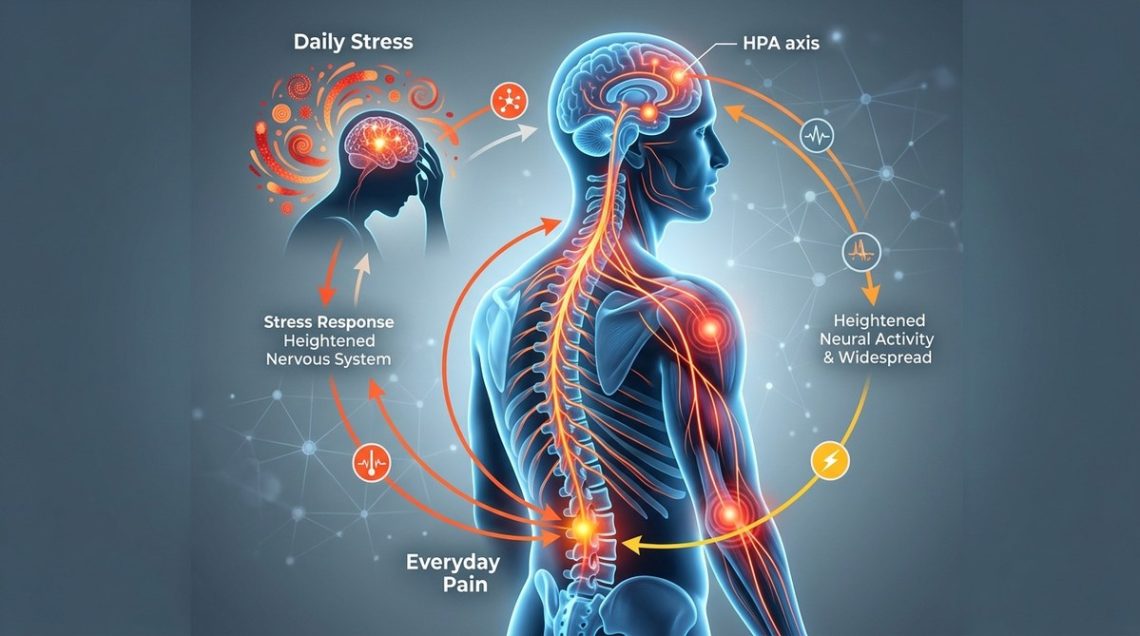
Here is where the stress and chronic pain connection becomes a vicious cycle. Pain itself is a stressor. When you are in pain, your body releases stress hormones to help you cope. If the pain is chronic, those hormones stay elevated. This keeps your nervous system in that hyper-alert state. And that hyper-alert state makes you feel more pain. You are trapped in a feedback loop.
- Pain triggers a stress response.
- The stress response keeps your body inflamed.
- Inflammation sensitizes your nerves.
- Sensitive nerves send more pain signals.
- More pain triggers more stress.
This loop is why rest alone often does not fix chronic pain. You cannot just “wait it out.” You have to actively interrupt the cycle. For a deeper look at how your brain gets stuck in this pattern, read about how chronic pain alters your brain and nervous system.
Inflammation: The Chemical Bridge Between Stress and Pain
Inflammation is a key player in the stress and chronic pain connection. When you are stressed, your body produces inflammatory cytokines. These are chemical messengers that tell your immune system to stay active. In the short term, this helps you heal from injury. In the long term, it creates a low-grade, whole-body inflammation.
This inflammation does not just stay in your joints or muscles. It affects your nerves directly. Inflamed nerves are more likely to fire. They are also more likely to send false alarms to your brain. This is why people under chronic stress often report pain in areas where there is no visible injury. The pain is real, but its source is the inflammatory environment created by stress, not tissue damage.
Three Steps to Break the Stress-Pain Cycle
You can interrupt this biological loop. It takes consistent effort, but the science supports it. Here is a numbered list of practical steps that target the stress and chronic pain connection directly.
-
Reset your nervous system with slow, deep breathing. This is not just a relaxation trick. Deep, slow breathing (in for four counts, out for six counts) activates your vagus nerve. This nerve is the main brake for your sympathetic nervous system. Doing this for two minutes can lower your heart rate and reduce cortisol levels. It tells your brain that the threat is over.
-
Use gentle, mindful movement to retrain your brain. Your brain learns safety through movement. When you move in a slow, controlled way (like in gentle yoga or tai chi), you send your brain a new signal. You are saying, “I am moving, but I am not in danger.” This helps lower your nervous system’s baseline alert level. Over time, this can raise your pain threshold.
-
Create a predictable daily routine for your body. Your nervous system craves predictability. When your sleep, meals, and activity happen at roughly the same time each day, your body can better regulate its stress response. This reduces the random spikes in cortisol that keep your pain system on edge. Even a small amount of routine can make a big difference.
Common Mistakes That Worsen the Connection
Many people try to manage their pain but accidentally make the stress and chronic pain connection stronger. Here is a table of common mistakes and what to do instead.
| Mistake | Why It Backfires | A Better Approach |
|---|---|---|
| Pushing through the pain to exercise | This reinforces the “danger” signal to your brain, increasing sensitivity. | Stop at the first hint of sharp pain. Focus on movement that feels safe. |
| Using alcohol or sleep aids to relax | These disrupt your sleep architecture and increase inflammation. | Prioritize sleep hygiene and natural relaxation techniques. |
| Ignoring stress and “just dealing with it” | This keeps your nervous system in high alert mode. | Acknowledge the stress. Use a short breathing exercise to reset. |
| Focusing only on the physical pain location | This ignores the systemic role of the nervous system. | Treat the whole system with stress management, not just the painful spot. |
The Role of Central Sensitization
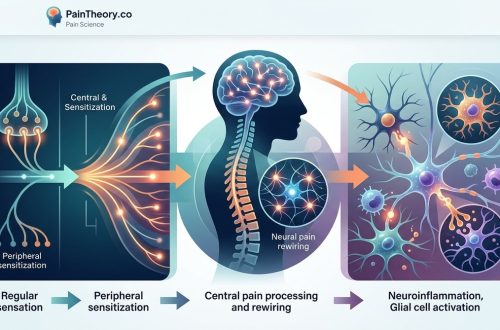
You may have heard the term “central sensitization.” It describes a condition where your central nervous system (your brain and spinal cord) becomes stuck in a state of high reactivity. This is a core part of the stress and chronic pain connection. When your brain is sensitized, it does not need a strong signal from your body to create pain. It can generate pain on its own.
Think of it like a car alarm that goes off when a leaf falls on the windshield. The alarm is not broken. It is just set to a sensitivity level that is too high for your current environment. Central sensitization works the same way. Your brain’s alarm system needs to be recalibrated. This recalibration happens when you consistently lower your stress levels and provide your brain with safe, non-threatening sensory input. To understand this process further, you can learn about the role of central sensitization in chronic pain.
What the Experts Say
“The nervous system is designed to protect you. When it perceives constant threat, it keeps the pain signals turned on as a protective measure. The key to recovery is not fighting the pain, but teaching the nervous system that it is safe. This is done through predictable, gentle, and consistent actions that lower the perceived threat level.” – Dr. Sarah M. (Paraphrased from clinical pain research)
This perspective shifts the goal. You are not trying to “cure” a broken body part. You are trying to reassure a hyper-vigilant nervous system. This is a much more achievable goal, and it is the most direct path to breaking the stress and chronic pain connection.
Practical Strategies for Daily Life
You do not need a complete life overhaul to start seeing results. Small, consistent actions are more effective than big, unsustainable changes. Here are a few strategies you can start using today:
- Morning check-in: Before you get out of bed, take three slow breaths. Place a hand on your chest and feel it rise and fall. This sets a calm tone for your nervous system.
- Workday reset: Set a timer for every 90 minutes. When it goes off, stand up, stretch your arms overhead, and take five slow breaths. This prevents the buildup of tension that feeds the stress-pain loop.
- Evening wind-down: One hour before bed, dim the lights and put your phone away. Read a physical book or listen to calm music. This helps your body produce melatonin and shift into a rest state.
For more ideas on how to manage this cycle through your daily habits, check out 5 stress management techniques that actually reduce physical pain.
Your Nervous System Is Listening
The stress and chronic pain connection is not a life sentence. Your nervous system is plastic. It can change. Every time you choose a slow breath instead of a tense reaction, you are sending a signal. Every time you move gently instead of pushing through pain, you are teaching your brain safety. These signals add up. They build new neural pathways that favor calmness over alarm.
You do not have to fix everything at once. Start with one breath. Start with one gentle stretch. Your body is listening. It wants to find its way back to balance. Give it the right signals, and it will begin to quiet the alarm. This is not about willpower. It is about biology. And biology responds to consistency, not perfection.