If you live with lower back pain, you know that bedtime can feel like a battleground. You toss. You turn. You try to find that one sweet spot where your spine stops screaming. And just when you think you have it, you wake up three hours later feeling stiff and sore. It is a frustrating cycle that robs you of rest and leaves you drained for the day ahead. The good news is that small, intentional changes to your sleep setup can break that cycle. By adjusting your sleep positions for lower back pain, you can reduce pressure on your spine, support your natural curves, and finally get the deep sleep your body needs to heal.
Sleeping on your side with a pillow between your knees is the gold standard for lower back pain relief. Back sleepers should place a pillow under their knees to maintain the natural curve of the spine. Stomach sleeping is the worst position for back pain and should be avoided or modified with a flat pillow under the hips.
Why Your Sleep Position Matters More Than Your Mattress
Many people assume that buying a new mattress will fix their back pain overnight. While support matters, your sleep position has a bigger impact on spinal alignment than the surface you sleep on. Think of it this way: even the best mattress cannot fix a twisted spine. When you sleep in a position that forces your spine out of its natural S-curve, you create uneven pressure on your discs, joints, and muscles. Over time, this leads to stiffness, inflammation, and more pain.
Your spine has three natural curves: the cervical curve in your neck, the thoracic curve in your mid-back, and the lumbar curve in your lower back. The goal of any good sleep position is to maintain those curves without adding extra twist or bend. When you get this right, your muscles can fully relax. Your discs can rehydrate. And your body can focus on repair instead of fighting against poor alignment.
If you want to understand why your pain feels worse at night, read our guide on why your lower back pain gets worse at night and what to do about it.
The Three Best Sleep Positions for Lower Back Pain
Not all sleep positions are created equal. Some put your spine in a neutral position. Others force it into awkward angles. Here are the three positions that experts recommend most often.
1. Side Sleeping with a Pillow Between Your Knees
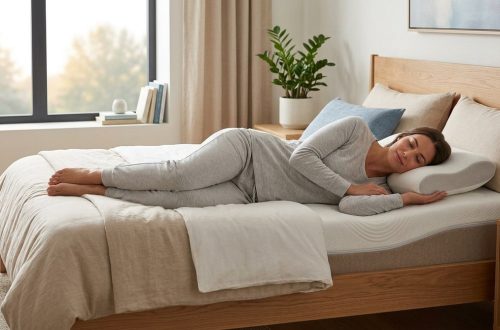
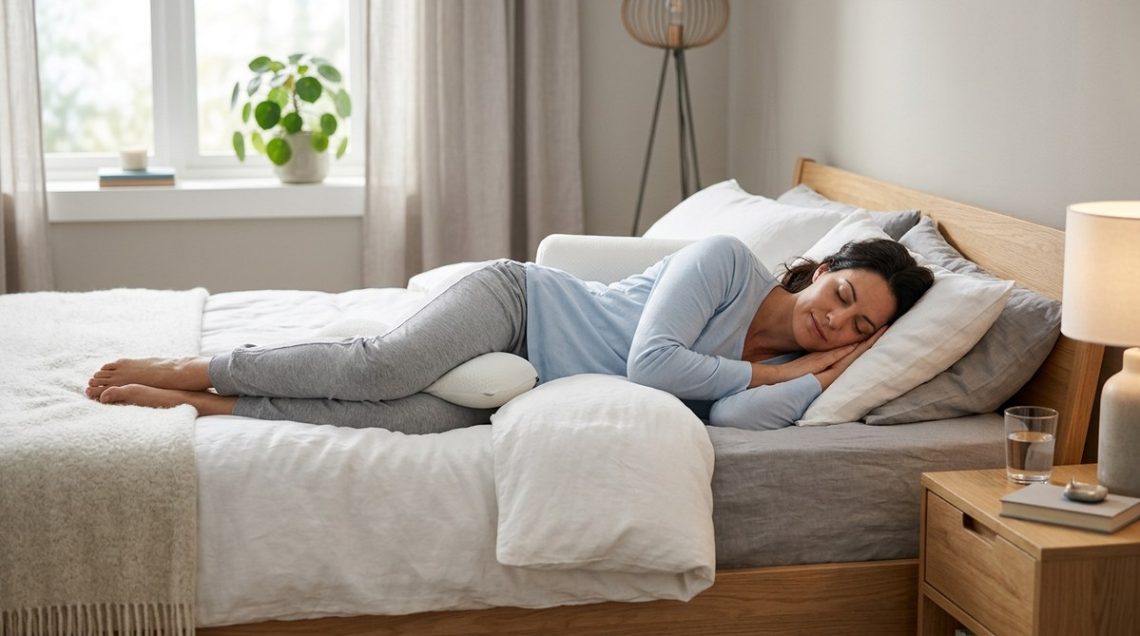
This is the number one recommended position for lower back pain. When you sleep on your side, your top leg naturally drops down toward the mattress. This rotation pulls on your pelvis and twists your lower spine. Placing a firm pillow between your knees stops that rotation and keeps your hips, pelvis, and spine in a straight line.
To get this right:
– Lie on your side with your knees bent slightly.
– Place a pillow between your knees that is thick enough to keep your top knee level with your hip.
– Hug a second pillow to your chest to support your upper body and prevent your shoulders from rolling forward.
If you have hip pain along with your back pain, this position also takes pressure off the top hip joint.
2. Back Sleeping with a Pillow Under Your Knees
Sleeping on your back is the second best option. It distributes your weight evenly across the mattress and keeps your spine in a neutral position. The problem is that most people’s lower back arches away from the mattress when they lie flat. This creates a gap that strains the lumbar muscles.
Placing a pillow under your knees solves this. It lifts your legs slightly, which tilts your pelvis backward and flattens your lower back against the mattress. This reduces the arch and takes pressure off the lumbar spine.
For extra support, use a small rolled towel or a lumbar roll behind your lower back. This fills any remaining gap and keeps your spine in a neutral position all night.
3. The Fetal Position (Modified)
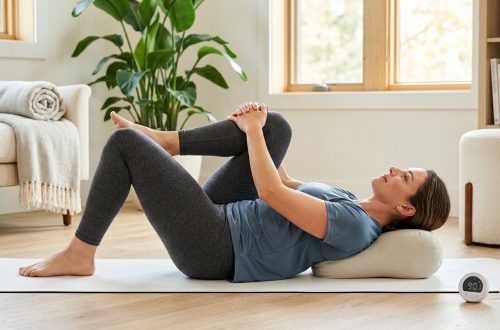
The fetal position can be helpful for people with disc-related back pain, such as a herniated or bulging disc. Curling into a gentle C-shape opens up the spaces between your vertebrae and reduces pressure on the spinal nerves.
The key is to keep the curl gentle. Do not tuck your knees all the way to your chest. Instead, bend them to about a 45-degree angle. Keep your chin neutral rather than tucked down. And still use a pillow between your knees to prevent pelvic rotation.
This position works best for people who have pain that radiates down one leg, which is often a sign of sciatica or disc issues.
Sleep Positions to Avoid
Some positions are almost guaranteed to make your lower back pain worse. Here is what to watch out for.
| Position | Why It Hurts | What to Do Instead |
|---|---|---|
| Stomach sleeping | Flattens the natural curve of your spine and forces your neck to twist to the side. This puts stress on both your lower back and your cervical spine. | Switch to side sleeping. If you cannot break the habit, place a flat pillow under your hips and lower abdomen to reduce the arch in your lower back. |
| Side sleeping without a knee pillow | The top leg drops down and twists the pelvis, which strains the lower back and hip joints. | Add a pillow between your knees immediately. This single change can reduce morning stiffness significantly. |
| Back sleeping with legs straight | The lower back arches away from the mattress, creating a strain on the lumbar muscles and discs. | Place a pillow under your knees to flatten the lower back against the mattress. |
How to Choose the Right Pillows and Mattress
Your pillows and mattress work together to support your sleep position. Here is what to look for.
Pillow Height Matters
A pillow that is too thick or too thin can throw your spine out of alignment. For side sleepers, your pillow should fill the space between your ear and the mattress so your neck stays in a straight line with your spine. For back sleepers, use a thinner pillow that keeps your head in a neutral position without pushing it forward.
Mattress Firmness
Medium-firm mattresses tend to work best for lower back pain. They provide enough support to keep your spine aligned while still offering pressure relief for your hips and shoulders. If your mattress is too soft, your hips sink down and your spine twists. If it is too firm, your pressure points hurt and you toss more at night.
If you cannot replace your mattress right now, try a mattress topper. A two to three inch memory foam topper can make a firm mattress more forgiving without losing support.
A Step-by-Step Process to Test Your Setup
You do not need to overhaul your entire bedroom in one night. Use this simple process to find what works for you.
- Start with your current sleep position. Lie down in the position you naturally use most often.
- Check your alignment. Have someone take a photo, or use a mirror to look at your spine from the side. Your ear, shoulder, hip, and ankle should form a straight line.
- Adjust one variable at a time. Add a knee pillow. Swap your pillow for a thinner or thicker one. Try a lumbar roll.
- Sleep in the new setup for three nights. Give your body time to adjust before making another change.
- Rate your morning pain on a scale of 1 to 10. If it improves, keep the change. If not, try a different adjustment.
Additional Tips for a Pain-Free Night
Beyond your sleep position, a few simple habits can make a big difference in how you feel in the morning.
- Use a bedtime routine that includes gentle stretching. Our guide on 7 gentle yoga poses that actually help lower back pain offers poses you can do right before bed.
- Apply heat for 15 minutes before sleep. A heating pad relaxes tight muscles and increases blood flow to sore areas.
- Check your pillow height every six months. Pillows lose loft over time and may stop providing proper support.
- Keep your bedroom cool. A room temperature between 65 and 68 degrees Fahrenheit promotes deeper sleep, which helps your body repair.
If stress is contributing to your pain, you might find relief by reading about 5 stress management techniques that actually reduce physical pain.
Common Mistakes People Make
Even with good intentions, people often fall into these traps.
- Using too many pillows. Stacking pillows under your head forces your neck into a sharp angle. One supportive pillow is better than two fluffy ones.
- Sleeping on an old mattress. Most mattresses last seven to ten years. If yours is older, it may have sagging spots that ruin your alignment no matter how you position yourself.
- Ignoring hip pain. Lower back pain often starts in the hips. If your hips are tight or sore, they pull on your lower back. Stretching your hip flexors and glutes during the day can help.
When to See a Professional
These sleep adjustments can help with mild to moderate lower back pain. But some situations require medical attention. If your pain does not improve after two weeks of trying these changes, or if you have numbness, tingling, or weakness in your legs, it is time to see a doctor. You should also seek care if your pain started after a fall or injury, or if you have trouble controlling your bladder or bowels.
Our article on 5 back pain red flags that mean you should see a doctor immediately can help you decide when to seek help.
Your Path to Restful Nights Starts Tonight
You do not need a complete bedroom makeover to sleep better with lower back pain. You just need a few targeted changes. Start with your sleep position. Add a pillow between your knees if you sleep on your side. Put a pillow under your knees if you sleep on your back. And if you sleep on your stomach, work on transitioning to a side position over the next few weeks.
These small adjustments add up. When your spine is properly aligned all night, your muscles relax, your discs recover, and you wake up with less stiffness and more energy. Give your body the support it deserves. Your morning self will thank you.