If you work on your feet, you know the drill. By 2:00 PM, your lower back starts to ache. By 5:00 PM, you are shifting your weight from foot to foot, trying to find any position that takes the pressure off. You might blame your shoes, the concrete floor, or just getting older. But the real reason your back hurts when standing all day is more subtle and fixable than you think.
Standing all day triggers back pain because your core and glute muscles fatigue, forcing your spine to bear the load alone. The fix is not more rest. It is smarter movement, better footwear, and targeted strengthening. This article breaks down why your back hurts, the three biggest mistakes people make, and a simple plan to stay pain-free on the job.
What Actually Happens to Your Spine When You Stand Still
Standing still seems harmless. Your legs are straight, your spine is upright, and you are not lifting anything heavy. But the problem is the stillness itself.
Your body is designed to move. When you stand in one place for hours, your muscles have to work continuously to keep you upright. The muscles in your lower back, hips, and core are holding a low-level contraction the entire time. After about 30 minutes, those muscles start to fatigue. When they get tired, they stop doing their job properly.
At that point, your spine starts to take the load directly. The small joints in your lower back, called facet joints, get compressed. The discs between your vertebrae get squeezed unevenly. Your pelvis may tilt forward, which increases the curve in your lower back and puts extra strain on the muscles there.
This is why your back hurts when standing all day. It is not a single injury. It is the slow buildup of fatigue, compression, and poor alignment that accumulates over hours.
The Three Mistakes That Make Standing Pain Worse
Most people try to tough it out or rely on one fix, like a better pair of shoes. But there are three common mistakes that keep the pain cycle going.
| Mistake | Why It Hurts You | What To Do Instead |
|---|---|---|
| Standing perfectly still | Blood pools in your legs, muscles stiffen, and joints get compressed | Shift your weight every 5 to 10 minutes or walk a few steps |
| Locking your knees | This puts all the pressure into your lower back and reduces shock absorption | Keep a soft bend in your knees at all times |
| Wearing flat, unsupportive shoes | Shoes without arch support let your feet roll inward, which twists your pelvis | Use shoes with good arch support or add an orthotic insole |
These three mistakes stack on top of each other. If you stand still with locked knees in flat shoes, your back is taking a beating from all angles.
A Simple 3-Step Process to Stop the Pain
You do not need a complete career change to feel better. You just need a new approach to how you stand. Here is a step-by-step process you can start using today.
-
Reset your standing posture every 20 minutes. Set a timer on your phone or watch. When it goes off, do a quick check. Soften your knees, tuck your tailbone slightly under (like you are trying to close a zipper), and pull your belly button in toward your spine. Hold this for 10 seconds. This resets your alignment and wakes up your core.
-
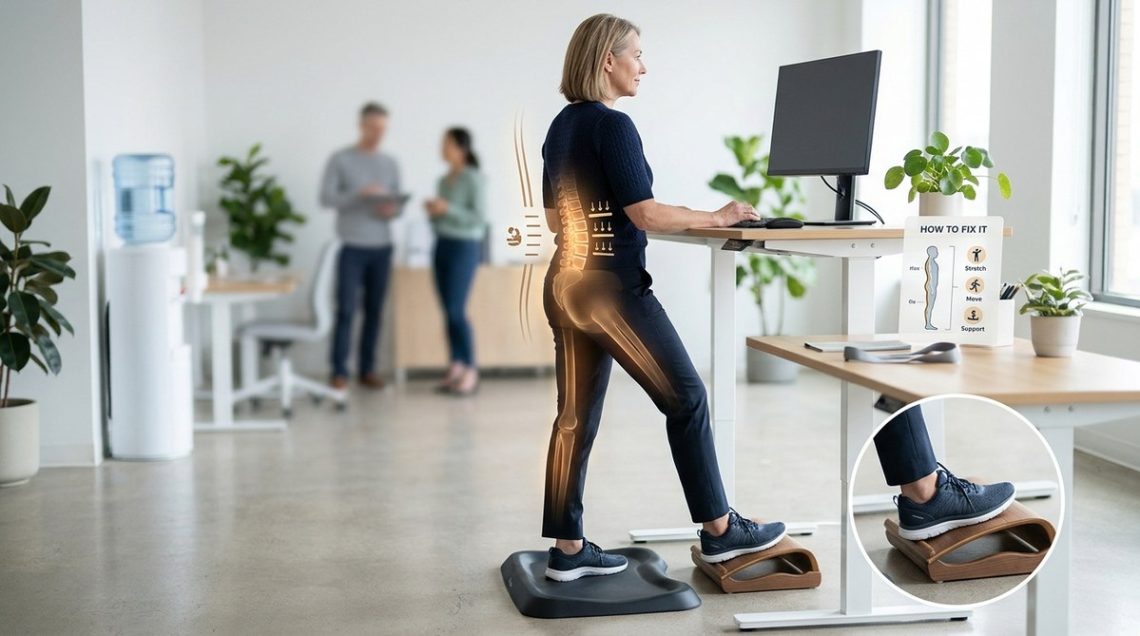
Use a footrest or anti-fatigue mat. If you stand at a counter or register, put one foot up on a small stool or a stack of thick books. This tilts your pelvis and takes pressure off your lower back. Switch feet every 10 to 15 minutes. If you can, use an anti-fatigue mat. These mats have a slight give that encourages micro-movements in your legs, which keeps blood flowing.
-
Do a 60-second stretch break every hour. Step away from your station. Do a standing hamstring stretch by putting one heel on a step and leaning forward gently. Then do a hip flexor stretch by stepping one foot back and bending the front knee. These two stretches target the muscles that get tightest from standing.
Expert Advice: “The single most effective thing you can do for standing-related back pain is to never stand still for more than 20 minutes at a time. Even a 30-second walk to the other side of the room resets the load on your spine and re-engages your core muscles.” — Dr. Sarah Mitchell, physical therapist specializing in workplace ergonomics.
What to Look for in Your Work Shoes
Your shoes are your foundation. If your foundation is off, everything above it suffers. Here is what to look for when choosing shoes for standing all day.
- Arch support. Look for shoes that have a noticeable arch. If your foot is flat, your ankle rolls inward, which rotates your shin bone and pulls your pelvis out of alignment. That torque travels straight to your lower back.
- Cushioning in the heel. The heel should have enough padding to absorb the shock of each step. If you can feel the ground through the sole, the shoe is too thin.
- A slight heel lift. A shoe with a small heel (about half an inch to one inch) takes pressure off your Achilles tendon and helps keep your pelvis in a neutral position. This is why many nurses and restaurant workers prefer clogs or shoes with a modest heel.
- Room in the toe box. Your toes should be able to spread out. If they are cramped, your foot cannot stabilize properly, and that instability travels up your chain.
If you cannot afford new shoes right now, try an over-the-counter orthotic insole. It can make a huge difference for about 20 dollars.
Strengthening Exercises That Protect Your Back
The best long-term solution is to build strength in the muscles that support your spine. You do not need a gym membership. These three exercises can be done at home in under 10 minutes.
- Glute bridges. Lie on your back with your knees bent and feet flat on the floor. Push through your heels to lift your hips up. Squeeze your glutes at the top, then lower down slowly. Do 15 repetitions. This wakes up your glutes, which are often weak in people who stand a lot.
- Plank holds. Get into a push-up position but rest on your forearms instead of your hands. Keep your body in a straight line from your head to your heels. Hold for 20 to 30 seconds. This builds endurance in your core, which takes load off your lower back.
- Standing calf raises. Stand with your feet hip-width apart. Rise up onto your toes as high as you can, then lower down slowly. Do 20 repetitions. Strong calves help pump blood back up from your feet and reduce fatigue in your legs.
Do these exercises three times per week. Within two weeks, you should notice that your back hurts less during your shift.
When Standing Pain Signals Something More Serious
Most standing-related back pain is mechanical. It comes from fatigue and poor posture. But sometimes, the pain is a sign of an underlying condition that needs medical attention.
You should see a doctor if your back pain:
- Radiates down one leg past the knee
- Is accompanied by numbness or tingling in your legs or feet
- Does not improve after changing your standing habits for two weeks
- Started after a fall or accident
- Comes with fever, unexplained weight loss, or loss of bladder control
These symptoms could indicate a herniated disc, sciatica, or other spinal issues that require professional treatment. Do not ignore them.
If you want to learn more about how the nervous system creates and maintains pain, check out our guide on why does pain become chronic. Understanding that process can change how you approach your recovery.
Small Changes That Add Up Over a Shift
You do not have to overhaul your entire routine overnight. Start with one change today. Maybe it is the footrest. Maybe it is the 20-minute posture reset. Maybe it is just remembering to bend your knees.
The key is consistency. Every time you catch yourself standing still with locked knees, you have a chance to make a better choice. Over a full shift, those small choices add up to significantly less pain.
If you also sit for long periods during your commute or breaks, you might benefit from our desk worker’s guide to preventing sitting-related back pain. The same principles apply: movement is medicine.
Your Action Plan for a Pain-Free Workday
Here is a summary of what to do starting tomorrow morning.
- Wear supportive shoes with arch support and a small heel
- Place an anti-fatigue mat or footrest at your workstation
- Set a timer to reset your posture every 20 minutes
- Take a 60-second stretch break every hour
- Do glute bridges, planks, and calf raises three times per week
- See a doctor if pain radiates down your leg or does not improve
Your back is telling you something when it hurts. It is not broken. It is just asking for a little help. Give it the support and movement it needs, and you will be amazed at how much better you feel by the end of your shift.
You spend too many hours on your feet to let pain control your day. Start with one change today. Your back will thank you.